Seated vs Standing Support Yoga: Best Options for Seniors
When people search for seated vs standing yoga, they usually want a simple answer: which one feels safer, easier, and actually worth doing? For most seniors, the better choice is not one or the other forever. It depends on balance, leg strength, fatigue, joint comfort, and confidence. Seated yoga gives you more stability and takes the pressure off balance. Standing yoga asks more from your legs, feet, and core, which can be a good thing if your body is ready for it.
Here’s the thing: “harder” does not always mean “better,” and “gentler” does not mean “less effective.” Seated support yoga for seniors can improve mobility, posture, breathing, and upper-body strength without the stress of worrying about a fall. Standing support yoga can build leg endurance, hip stability, and balance in a way that transfers more directly to daily life, like getting out of a chair or walking across a room without feeling wobbly. The smart move is choosing the version that challenges you just enough without making you tense. If you spend the whole session bracing and worrying, the exercise is not matching your body well.
Choose Seated Yoga if Balance Anxiety Is Running the Show
Seated yoga is often the best starting point for anyone who feels unsteady, gets dizzy when changing positions, has neuropathy in the feet, or simply hates the feeling of possibly tipping over. That last part matters. If you feel nervous, your shoulders tighten, your breathing gets shallow, and your body never fully relaxes into the work. Chair-based movement removes a lot of that fear right away. You can focus on moving your spine, shoulders, hips, and ankles instead of spending all your energy trying not to wobble.
This is also why chair yoga alternatives matter. Not every seated practice has to be soft and sleepy. A good seated session can include strong arm reaches, core twists, marching legs, heel lifts, ankle circles, posture drills, and breath-led side bends that wake up the torso. It works especially well for seniors with arthritis, post-surgery limitations, or days when stamina is low. If getting down to the floor is a hassle, seated support yoga for seniors is often more realistic than mat-based yoga anyway. Realistic beats idealized every time. The best routine is the one you will actually repeat three or four times a week without dreading it.
Standing Support Yoga Makes Sense When You Want Better Everyday Balance
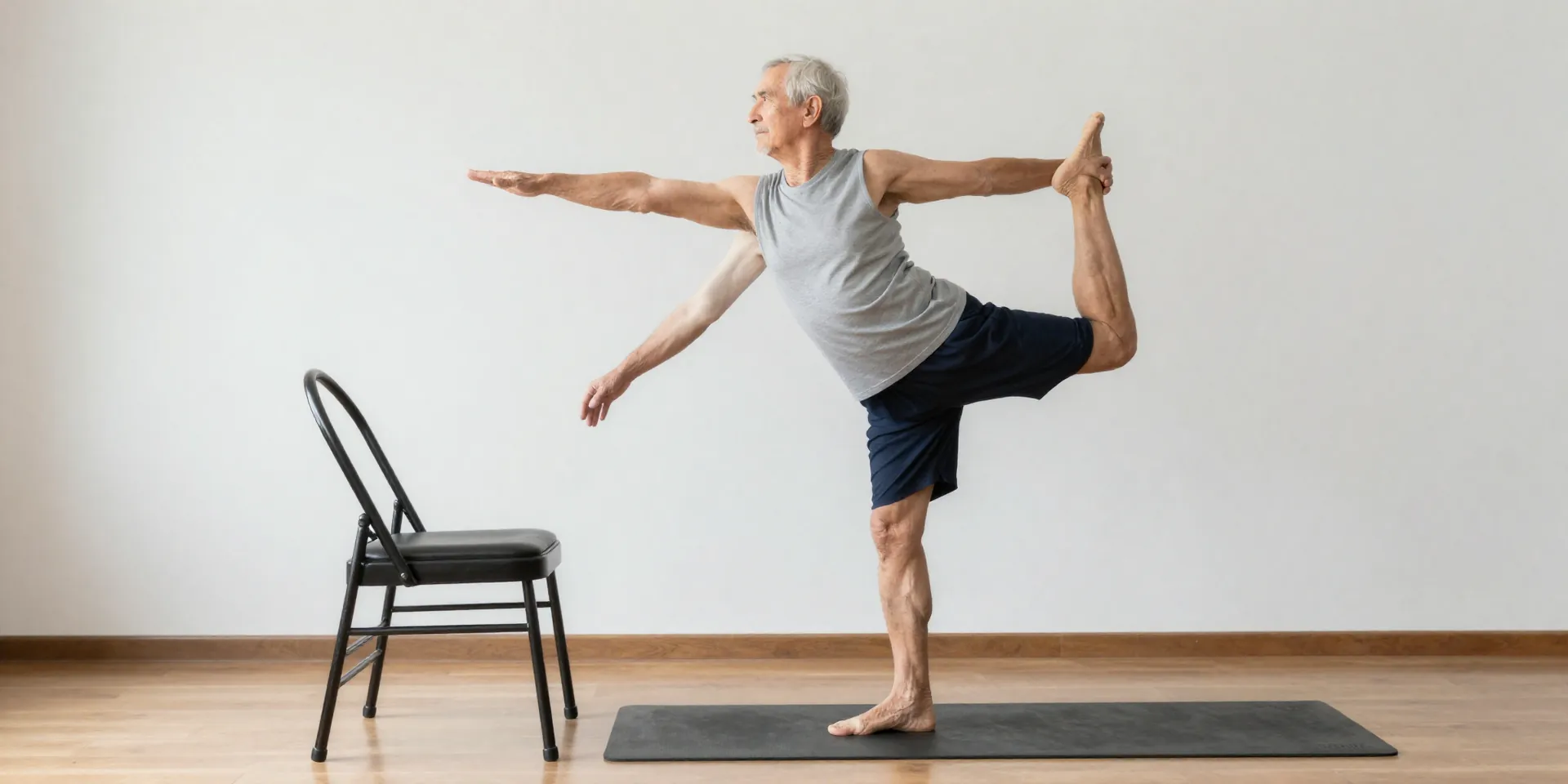
If your balance is decent and you can stand comfortably for a few minutes, standing support yoga can do things seated work cannot fully replace. It trains your body in the same position where most falls happen: upright. That matters. Standing poses teach your ankles, calves, hips, and core to cooperate. Even simple movements like supported heel raises, mini side leg lifts, gentle chair-assisted lunges, or a light version of tree pose can improve how steady you feel walking, turning, and reaching.
But standing yoga for seniors should not mean free-standing poses in the middle of the room unless that’s truly appropriate. A chair, countertop, wall, or barre can turn a shaky experience into a productive one. Think of support as a tool, not a crutch. Balance-friendly exercise is not about proving anything. It is about practicing enough challenge that your body adapts without crossing into panic. One useful rule: if your standing practice makes you grip with your toes, hold your breath, or lean hard into the support, you are probably pushing past the sweet spot. Back it up a notch. A lighter version done well beats a dramatic version done badly.
How to Pick the Right Option Based on Your Body, Not Your Ego
A quick self-check can usually tell you where to start. Go seated first if you feel unsteady walking, rely heavily on furniture around the house, have pain flares that change day to day, or tire out fast. Choose standing support work if you can rise from a chair without using your hands most of the time, stand at the kitchen counter comfortably, and recover your balance quickly after small shifts in position. If you are somewhere in the middle, mix both. That is often the sweet spot.
There is no prize for skipping the chair. A lot of people quietly assume seated yoga is for “older” seniors and standing yoga is for “fit” seniors. That’s too simplistic. Some people have excellent upper-body mobility but unreliable knees. Others can stand fine but struggle with spinal stiffness and do better warming up seated first. A smart routine often starts in the chair, moves into supported standing, then returns to seated work for cooldown and mobility. That sequence gives you the best of both approaches. It also respects how the body behaves on real days, not imaginary perfect ones. If an exercise plan does not adapt to your energy, it is not a very good plan.
The Best Chair Yoga Alternatives When You Want More Variety
Some seniors get bored with classic chair yoga, and fair enough. The answer is not necessarily to abandon support yoga for seniors. It is to widen the menu. Good chair yoga alternatives include wall yoga, countertop stretching, standing sequences with one hand on a chair, and sit-to-stand drills paired with gentle mobility work. Even a short routine that alternates seated spinal movement with supported standing balance practice can feel much more engaging than staying in one position the entire time.
One practical combo looks like this: seated posture reset, seated knee lifts, standing calf raises while holding a chair, gentle side steps, wall chest opener, then seated breathing and neck release. That kind of routine covers mobility, circulation, posture, and confidence without demanding floor transfers or athletic balance. It also makes room for progression. Over time, you might reduce how much pressure you put on the chair, stand a little longer, or hold a supported pose for a few extra breaths. Progress in senior fitness is often subtle. Better turning, steadier walking, easier stairs, less fear getting dressed while standing on one leg for a second. Those wins count, even if they do not look dramatic.
What a Safe, Effective Weekly Routine Actually Looks Like
If you want a clear recommendation, start with three or four short sessions a week instead of one heroic session that leaves you sore and annoyed. For beginners, 15 to 25 minutes is plenty. A balanced week might include two seated-focused days and one or two standing-support days. On seated days, emphasize spinal mobility, shoulder range of motion, ankle movement, breathing, and light core engagement. On standing days, keep one hand near a chair or wall and work on heel raises, weight shifts, mini squats to a chair, hip abduction, and gentle posture holds.
Watch for signs that the routine fits. You should feel worked, but not rattled. Mild muscle fatigue is fine. Sharp pain, dizziness, lingering joint irritation, or a surge of fear is not. And no, you do not need fancy yoga poses to make this worthwhile. The point of balance-friendly exercise is carrying strength and confidence back into normal life. Can you stand at the sink more comfortably? Turn around with less hesitation? Reach into a cabinet without feeling unstable? That is the standard that matters. If seated practice helps you feel mobile and calm, it is doing its job. If supported standing helps you feel more capable on your feet, it is doing its job too.